
Ecuador shrimp exports to US, Europe fall; Asia sales keep growing
February 9, 2016
Alicia Villegas
Ecuador’s shrimp exports to Asia increased further for the full year 2015, boosted by a sharp increase already reported in December last year.
On the other hand, shrimp shipments to the US went down last year, as Ecuador producers have had an incentive and preference to sell head-on shrimp, which has squeezed the US market share for Ecuadorian product.
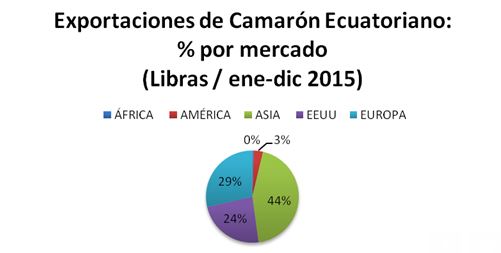
Last year, Ecuadorian shrimp exports totaled a record-high of 720 million pounds, of which 44% went to Asia; 29% to Europe and 24% to the US (see image below), according to statistics from the National Chamber of Aquaculture (CNA, in Spanish).
Compared to 2014 figures provided by consultant Gabriel Luna, shown to attendees at last year’s Aquaexpo event held in Guayaquil, exports to Asia increased 13 percentile points in 2015, driven by increasing demand throughout the last three years.
From 2013, when the early mortality syndrome (EMS) ravaged South East Asia’s shrimp production, exports to the Asian country boomed from Ecuador.
China imported 60 million pounds in 2015, accounting for 20% of the total exports to Asia, according to CNA figures.
“There’s no doubt about the huge demand from Asian countries, China has an important weight in Ecuador’s exports, as this market has a growth rate of 70%, while South Korea is also an interesting market,” Jose Antonio Camposano, CNA executive chairman, told Undercurrent News.
Ecuador’s shrimp exports to the US, however, went down six percentile points in 2015 on the back of “aggressive” exports from India to a price-focused US market, but also due to better prices for Ecuadorian head-on shrimp to Asia.
“The US is buying big volumes of cheaper shrimp from India, so Ecuador has lost competitiveness in the export of value-added shrimp,” Camposano said.
“India, with a different business structure than Ecuador, sells cheaper shrimp to the US and it’s gaining market share there, while value-added shrimp from Ecuador has higher production costs, so it cannot compete,” Camposano said.
Sales to the US are not competitive either, because the Chinese market pays better prices for whole shrimp [HOSO, head-on shell-on], production of which also involves less costs than tail-on shrimp, industry sources told Undercurrent previously.
This has seen processors shifting from tail-on shrimp to HOSO in order to cut costs amid a period of falling shrimp prices globally.
“It’s more attractive to sell whole shrimp to Asia, with a growing demand for Ecuadorian shrimp. The US, for its part, has a price-focused market, despite the continuous reports on irregularities from some Asian countries, such as labor scandals or problems with antibiotics, while Ecuador meets 100% all the standards,” Camposano said.
Ecuador exports to Europe decreased by five percentage points, and exports could not go up further on the back of the euro weakening, Camposano said.
European shrimp processors are not benefiting from falling vannamei prices due to the weakening of the euro as a cost driver, sources told Undercurrent previously.
“The currency impact is huge, it is a very important cost driver because we buy in dollars but we sell in euros, which makes prices to be higher,” a well-placed executive from a west European shrimp processor said last year.
